Background & Motivation
As semiconductor packages become increasingly complex and heterogeneous, reliability behavior is governed by highly nonlinear and coupled thermo-mechanical phenomena across multiple length scales. Conventional physics-based simulations provide high fidelity but suffer from excessive computational cost, while purely data-driven models lack physical consistency. Our research bridges this gap by embedding physical principles directly into neural network architectures, enabling fast yet physically consistent reliability prediction.
Package Structure Design Optimization
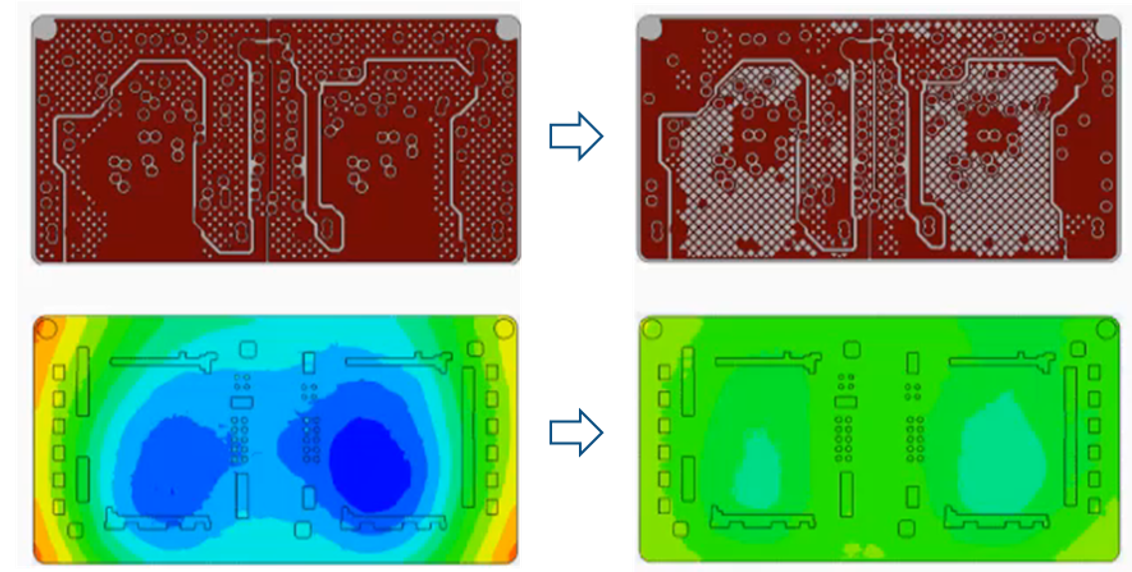
Physics-based neural network models are employed as fast surrogate solvers to evaluate package-level reliability metrics such as warpage and stress. This enables efficient exploration and optimization of package structures under physical constraints without relying on repeated full-scale simulations.
Real-Time Board-Level Reliability Prediction
The trained neural network models enable near real-time prediction of board-level reliability responses by directly mapping design and loading conditions to failure-related metrics. This capability supports rapid decision-making during design validation and system-level reliability assessment.
Methodology
- Physics-based simulation data generation for reliability responses
- Neural network training with embedded physical constraints
- Surrogate modeling for fast inference and optimization
Key Results & Impact
By integrating physics-based neural networks into the reliability analysis workflow, computational cost was significantly reduced while maintaining prediction accuracy. The proposed framework enables fast design optimization and real-time board-level reliability prediction, providing a foundation for reliability-aware digital twin systems.